







Deciding where to stay on the Amalfi Coast is the single most important choice you'll make before your trip. Pick the wrong town, and you'll spend half your vacation stuck in traffic on the SS163 instead of sipping Lacryma Christi on a sunlit terrace.
Here's what most guides won't tell you: each town along this 50-kilometer stretch of southern Italian coastline offers a radically different experience. Positano feels nothing like Ravello. Praiano has almost nothing in common with Sorrento. And the difference between a mediocre stay and an unforgettable one often comes down to matching your priorities, privacy, access, culture, nightlife, to the right village.
This guide breaks down the five best towns on the Amalfi Coast for luxury travelers, explains exactly who each one suits, and covers what to look for when booking a private villa. Whether you're planning a multi-generational family trip or a secluded retreat for two, you'll leave here knowing precisely where to book.
Key Takeaways
- Where to stay on the Amalfi Coast depends on your top priorities, rank privacy, access, and culture before choosing a town.
- Positano is best for first-time couples seeking glamour and nightlife, while Ravello suits travelers who crave hilltop serenity and panoramic views.
- Amalfi Town offers the most central base with ferry access, flat terrain, and easy day trips to neighboring villages.
- Praiano delivers authentic charm and unmatched sunset views at better value than Positano, ideal for repeat visitors seeking privacy.
- Sorrento is the smartest gateway for families, with direct train connections to Naples, Capri ferries, and walkable streets.
- Book your Amalfi Coast villa at least six months ahead and prioritize sea-view terraces, a private pool, and strong concierge support for the best experience.
How to Choose the Best Town on the Amalfi Coast for Your Stay
The best town on the Amalfi Coast depends on one thing: what you actually want from your trip. That sounds obvious, but most visitors default to Positano because it's the most photographed, and then discover it's not what they needed at all.
Start by asking yourself three questions:
- Do you want walkability or seclusion? Some towns require a car: others let you ditch one entirely.
- Are you prioritizing nightlife, culture, or quiet? The gap between these is enormous on the Amalfi Coast.
- How important is a central location for day trips? Ferry access and road connections vary wildly by town.
Here's the quick breakdown:
- Positano, Glamour, beaches, and world-class dining. Best for first-timers and couples.
- Ravello, Hilltop tranquility with 1,000-foot elevation views. Best for slow travel and cultural immersion.
- Amalfi Town, Central, flat, and historically rich. Best for families and history lovers.
- Praiano, Quiet, authentic, and uncrowded. Best for repeat visitors and privacy seekers.
- Sorrento, Convenient gateway with train access. Best for first-time visitors to the region and families with kids.
A 2024 survey by the Italian National Tourism Board found that 72% of luxury travelers who returned to the Amalfi Coast chose a different town on their second visit. That stat alone tells you how much the experience shifts from one village to the next.
Your action step: Before you read another word, rank these three priorities, privacy, access, culture, from most to least important. That ranking will guide every section below.
Positano: Iconic Cliffside Beauty and World-Class Privacy
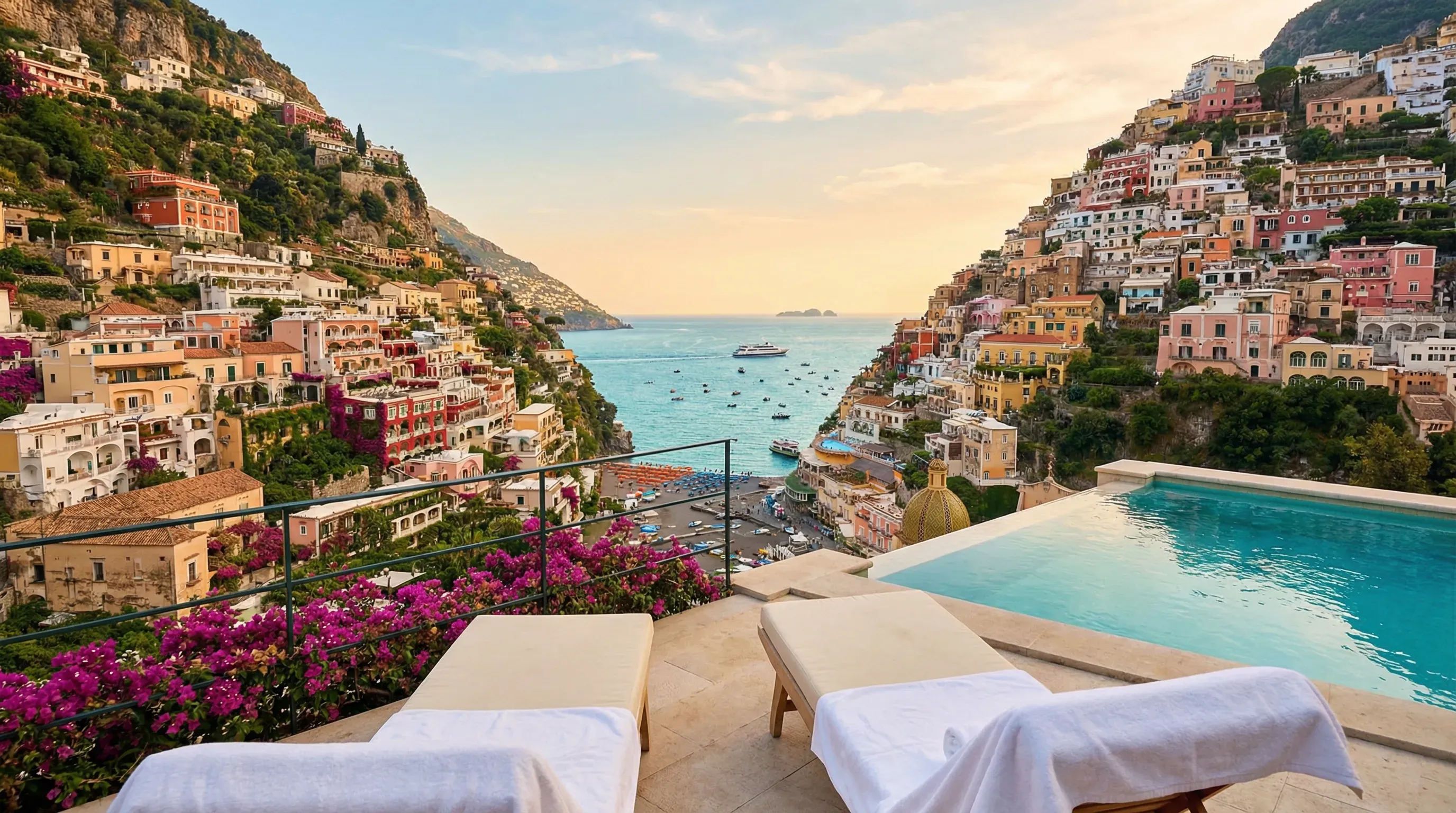
Positano is the town that made the Amalfi Coast famous. John Steinbeck wrote in 1953 that it "bites deep", and 70 years later, that line still holds up. Pastel-colored houses tumble down near-vertical cliffs toward the Tyrrhenian Sea. Bougainvillea drips from every railing. It's almost absurdly beautiful.
But Positano is more than a photo opportunity. For luxury travelers, it delivers a rare combination: genuine glamour alongside real privacy. The town's vertical layout means properties are naturally separated by elevation, terraces, and winding staircases, your nearest neighbor might be 200 steps away.
Spiaggia Grande is the main beach, where you can rent a front-row sunbed at Da Ferdinando for about €30 and watch boats shuttle guests to Capri. For something quieter, Fornillo Beach sits a short cliffside walk west. Boutiques line the steep lanes, Mode and Brunella are local favorites, and restaurants like La Sponda at Le Sirenuse serve dinner under 400 flickering candles.
Properties like Villa Aurora, a historic 1741 estate with 10 bedrooms and an infinity pool, show what Positano's high end really looks like: panoramic terraces, private grounds, and space for up to 20 guests.
What Makes Positano Ideal for Luxury Travelers
Three things set Positano apart for high-net-worth visitors:
- Ferry access without a car. Direct boats run to Capri, Amalfi, and Salerno from April through October, which means you can skip the notoriously narrow SS163 entirely.
- Density of fine dining. Within a 10-minute walk, you'll find Michelin-recognized restaurants, waterfront seafood spots, and wine bars pouring Campanian vintages you won't find stateside.
- Nightlife that actually exists. Unlike Ravello or Praiano, Positano has cocktail bars and late-night energy. Music on the Rocks, built into a sea cave, hosts DJ sets until 4 a.m. in summer.
For a more intimate setting, Villa Luana offers a clifftop retreat with private sea access and a 24-hour concierge, ideal if you want Positano's energy nearby but total seclusion at home.
Fair warning: Positano is the most expensive and most crowded town on the coast, especially in July and August. If quiet mornings matter more than vibrant evenings, keep reading.
Your action step: If Positano fits your style, book for late May or September. You'll get warm water, open restaurant terraces, and roughly 40% fewer tourists than peak summer.
Ravello: Elevated Elegance With Panoramic Views
Ravello sits 350 meters above sea level, and that altitude changes everything. There are no beaches here, no ferry docks, no beach clubs. What you get instead is silence, gardens, and views so expansive that composer Richard Wagner reportedly wept when he first saw them in 1880.
The town has roughly 2,500 year-round residents. On any given evening, you can walk from the Piazza Duomo to Villa Cimbrone's Terrace of Infinity, often called the most beautiful viewpoint in Italy, and encounter maybe a dozen other people after 6 p.m.
Ravello's annual music festival, held in the gardens of Villa Rufolo from June through September, draws world-class orchestras and soloists. Picture a string quartet performing at sunset with the sea 1,000 feet below. It's one of those experiences that justifies the entire trip.
For dining, Palazzo Avino's Rossellinis restaurant holds a Michelin star and serves creative Campanian cuisine on a terrace overlooking the coast.
Historic Estates and Hillside Retreats in Ravello
Ravello's real luxury asset is its historic estate inventory. Many properties here are converted from centuries-old palazzos with thick stone walls, vaulted ceilings, and terraced gardens that cascade toward the sea.
Villa Rondine, a clifftop property above Ravello with six bedrooms, a pool, and a 24-hour concierge, is a good example of what's available, the kind of place where you wake up to a view that makes getting out of bed feel optional.
Most Ravello villas include features that matter for extended stays:
- Private breakfast terraces with views you'd pay €50 per person for at a hotel
- Gardens and outdoor dining areas suited for intimate events or family meals
- Dedicated parking, essential here, because you will need a car or private driver
That last point is the honest trade-off. Ravello's elevation means you're a 15-minute drive from the coast road. You can't just stroll to a beach. For travelers who prize serenity over convenience, that distance is actually the point.
Your action step: If Ravello appeals to you, plan to hire a private driver for at least 3–4 days of your stay. It costs roughly €400–600 per day on the Amalfi Coast, but it transforms the experience entirely, no parking stress, no white-knuckling hairpin turns.
Amalfi Town: A Central and Culturally Rich Base
Amalfi Town itself is easy to overlook, most visitors treat it as a ferry stop between Positano and Ravello. That's a mistake.
The town was once the capital of a powerful maritime republic that rivaled Venice and Genoa in the 11th century. The Cathedral of St. Andrew, with its striped Moorish-Byzantine facade, dominates the main piazza and dates to the 9th century. The Paper Museum (Museo della Carta) still demonstrates paper-making techniques that Amalfi craftsmen invented centuries before the rest of Europe caught on.
For practical purposes, Amalfi Town is the most central base on the coast. Ferry routes radiate from its harbor to Positano, Salerno, and Capri. Buses and taxis connect to Ravello in about 25 minutes. And the town itself is relatively flat, a genuine rarity along this coastline, and a real benefit for families with young children or anyone who'd rather not climb 300 steps to dinner.
Properties like Villa Fatima, a 6-bedroom estate with ocean views and a pool, offer a balance of authentic Italian design and modern comfort that's hard to find in the busier towns.
Dining here skews traditional. Trattoria Da Gemma has been serving scialatielli ai frutti di mare since 1872. The lemon groves surrounding town produce the limoncello you'll find on every restaurant table.
Who this is for: Families, history lovers, and travelers who want a convenient base for exploring multiple towns without committing to just one.
Who it's not for: Privacy seekers or nightlife lovers. Amalfi Town is small, busy during the day, and mostly quiet after 10 p.m.
Your action step: If centrality is your top priority, book Amalfi Town and plan day trips to Ravello (morning) and Positano (afternoon) using the local ferry and bus network. You'll cover more ground with less driving.
Praiano: The Quiet Alternative for Discerning Guests
Praiano sits halfway between Positano and Amalfi, and it occupies a kind of sweet spot that repeat Amalfi Coast visitors tend to discover on their second or third trip.
The town has roughly 2,000 residents. There are no luxury hotel chains here. No designer boutiques. What you'll find instead: a handful of family-run restaurants, the 16th-century Church of San Gennaro, and Spiaggia della Gavitella, a small beach accessible by about 400 steps that rewards you with some of the clearest water on the coast.
Praiano's position gives it something no other town can match: unobstructed western exposure. While Positano faces south and Ravello faces inland, Praiano catches both sunrise over the mountains and sunset directly into the sea. Photographers and architects love this town for exactly that reason.
For luxury villa stays, Praiano offers exceptional value relative to Positano. Properties like Villa Francesca, a seafront home with indoor and outdoor pools, a private spa, and butler service, deliver five-star amenities in a setting that feels genuinely local.
The honest trade-off: Praiano has limited restaurant options (maybe 12 total) and no real nightlife. You'll need a car or driver. But if your idea of a perfect evening is grilled branzino on your own terrace while the sun drops into the Mediterranean, Praiano is hard to beat.
Your action step: If Praiano sounds right, book a villa with a private chef for at least half your stay. Dining in becomes the highlight rather than a compromise, and the sunset views from a private terrace outperform any restaurant on the coast.
Sorrento: A Sophisticated Gateway to the Coast
Sorrento isn't technically on the Amalfi Coast, it sits on the northern side of the Sorrentine Peninsula. But it functions as the primary gateway, and for many luxury travelers, especially families, it's the smartest base.
Here's why: Sorrento is the only town with a direct train connection. The Circumvesuviana line runs from Naples (and the airport) straight into Sorrento's center in about 70 minutes. From there, ferries depart daily to Capri (20 minutes), Positano (35 minutes), and Amalfi (50 minutes). You can also reach Pompeii and Herculaneum by train in under 30 minutes.
The town itself is polished and walkable. Corso Italia is lined with shops and restaurants. The Chiostro di San Francesco, a 14th-century cloister, hosts summer concerts. And the clifftop views toward Vesuvius from the Villa Comunale park are genuinely stunning.
Sorrento's lemon groves and artisan limoncello producers give it a distinct character. A visit to a working lemon farm, there are several that offer private tours, is one of those small, specific experiences that sticks with you.
For larger groups or multi-generational families, the area around Sorrento and nearby Sant'Agata offers properties with serious scale. Villa Anna, a historic 19th-century estate between Sorrento and Amalfi that sleeps 30 guests with a pool, tennis court, and even a helipad, is the kind of property that turns a family vacation into a family event.
Who this is for: First-time visitors to the region, families with children, and anyone who values transport convenience.
Who it's not for: Travelers seeking the dramatic cliffside drama of the Amalfi Coast's southern towns. Sorrento is beautiful, but it's a different kind of beauty, more manicured, less wild.
Your action step: If you're flying into Naples, consider spending your first and last nights in Sorrento to avoid the stress of same-day transfers along the coast road. It adds a buffer that makes the entire trip smoother.
Which Amalfi Coast Town to Stay In: Matching Your Priorities to the Perfect Location
If you've read this far, you probably have a frontrunner. But here's a clear comparison to confirm your instinct.
Choose based on your top priority:
| Priority | Best Town | Why |
|---|---|---|
| Beaches & nightlife | Positano | Walkable beaches, late-night bars, ferry access |
| Views & serenity | Ravello | 350m elevation, under 2,500 residents, music festival |
| Central location | Amalfi Town | Ferry hub, flat terrain, easy day trips |
| Authentic & uncrowded | Praiano | 2,000 residents, western sunsets, local feel |
| Transport & families | Sorrento | Train to Naples, ferries to Capri, walkable center |
For couples on a first trip: Start with Positano. It's the most complete single-town experience.
For families with children under 10: Sorrento wins. Flat streets, ice cream shops on every corner, and easy access to Pompeii make it practical without sacrificing charm.
For repeat visitors seeking something new: Praiano or Ravello. Both reward slower, more intentional stays.
For multi-generational groups of 10+: Consider splitting between two towns, book a large villa in one and plan group dinners at the other. The ferry between Positano and Amalfi takes just 20 minutes.
Which Amalfi Coast town to stay in eventually depends on what kind of memory you want to build. The coast is only 50 kilometers long, but the emotional distance between its villages is vast.
Your action step: Pick your town, then start your villa search at least 6 months before your travel dates. Peak-season inventory (June–September) at the luxury level often sells out by January.
What to Look for in a Luxury Villa on the Amalfi Coast
A villa stay on the Amalfi Coast is fundamentally different from a hotel. You're not buying a room, you're buying an entire experience, and the details matter more than you'd expect.
Here's what separates a good villa from a great one:
- Sea-view terraces with outdoor dining. This is non-negotiable. The terrace is where you'll spend 60% of your waking hours.
- Private pool or jacuzzi. Public beach access on the Amalfi Coast involves stairs, lots of them. A pool at your villa changes the daily rhythm entirely.
- Dedicated parking or a private driver arrangement. Parking on the Amalfi Coast is notoriously scarce. One villa we reviewed had guests parking 2 kilometers away and shuttling in.
- Air conditioning in every bedroom. Sounds basic, but many historic properties only have it in common areas. August temperatures regularly hit 34°C (93°F).
Private Amenities and Concierge Services
The real differentiator at the luxury level is concierge quality. A strong concierge doesn't just book restaurants, they secure the table you actually want, arrange a private boat to a hidden beach, and coordinate a chef who shows up with fresh catch from the Amalfi fish market at 6 a.m.
Specific services to look for:
- Pre-arrival provisioning, your villa stocked with your preferred wines, groceries, and baby supplies before you land
- Private boat charters, day trips to Capri's Blue Grotto or the Li Galli islands, with lunch arranged on board
- In-villa chef service, typically €150–300 per person for a multi-course dinner, which is often less than a comparable restaurant meal when you factor in transport and tips
- Airport transfers, private car from Naples Capodichino Airport takes about 75 minutes to most Amalfi Coast towns
At NCGVilla, co-founders Antonella D'Angelo and Ciro Cortese built their Amalfi Coast villa collection around this exact philosophy: personally curated properties with 24/7 concierge service that remembers your preferences from trip to trip. It's the difference between a transaction and a relationship.
Your action step: When evaluating any villa, ask three specific questions before booking: (1) Is the concierge on-call or on-site? (2) Can they arrange private boat transfers? (3) Do they coordinate with local chefs? The answers will tell you everything about the level of service you'll actually receive.
Conclusion
The Amalfi Coast covers barely 50 kilometers, but choosing where to stay on the Amalfi Coast shapes your entire experience, from the light that wakes you in the morning to the sounds that carry you to sleep.
Positano dazzles. Ravello calms. Amalfi connects. Praiano surprises. Sorrento simplifies. None of them is objectively "best." The right one is the one that matches how you actually want to spend your days.
If you take one thing from this guide, let it be this: book early, book a villa with real concierge support, and don't try to see everything in one trip. The Amalfi Coast rewards those who slow down. Pick your town, settle in, and let the coastline come to you.
Frequently Asked Questions
What is the best town to stay on the Amalfi Coast for first-time visitors?
For first-timers, Positano and Sorrento are the top picks. Positano offers iconic cliffside beauty, beaches, and nightlife, while Sorrento provides a walkable, family-friendly base with direct train access from Naples. Both let you explore via ferry without needing a car. Properties like Villa Aurora in Positano showcase what a luxury first visit can look like.
How do I choose where to stay on the Amalfi Coast based on my travel priorities?
Match your priorities to the right town: choose Positano for glamour and beaches, Ravello for panoramic views and serenity, Amalfi Town for a central base with ferry access, Praiano for authentic quiet, or Sorrento for transport convenience. Ranking privacy, access, and culture before booking helps narrow the decision quickly.
Is Praiano a good alternative to Positano on the Amalfi Coast?
Yes, Praiano is ideal for repeat visitors seeking privacy and authenticity without Positano's crowds or prices. It offers unobstructed western sunsets, crystal-clear beaches, and luxury villas like Villa Francesca with private spa and butler service. The trade-off is fewer restaurants and no nightlife, but that's exactly what draws discerning travelers.
What should I look for in a luxury villa rental on the Amalfi Coast?
Prioritize sea-view terraces, a private pool, dedicated parking, and full air conditioning in every bedroom. The most important differentiator is concierge quality, look for services like pre-arrival provisioning, private boat charters, and in-villa chef arrangements. Properties such as Villa Rondine above Ravello include 24-hour concierge and panoramic gardens.
When is the best time to visit the Amalfi Coast for fewer crowds?
Late May and September offer the best balance of warm weather, open restaurants, and roughly 40% fewer tourists than peak summer. Ferries and beaches are fully operational, and luxury villa availability is better than in July–August. Book at least six months ahead, as top properties often sell out by January for the peak season.
Can I stay on the Amalfi Coast without a car?
Yes, but it depends on your town. Positano and Sorrento are the most car-free-friendly, with ferry access and walkable centers. Amalfi Town is also manageable thanks to its flat terrain and ferry hub. Ravello and Praiano typically require a private driver, budget roughly €400–600 per day. For large groups, a villa like Villa Anna near Sorrento offers dedicated parking and helipad access.